
Last reviewed: July 4, 2026
If you are weighing premium economy vs business class long haul, you are really comparing two very different ways to cross oceans. This guide focuses on what actually changes for your body, sleep, privacy, dining, and time on the ground, and how to decide if the upgrade is worth it for your specific trip without relying on hype or guarantees.
Key takeaways at a glance
- For most travelers, the biggest change is lie-flat sleep, which is standard in modern business class but not in premium economy.
- Premium economy improves seat comfort, space, and dining over economy, often at a fraction of business class prices.
- Business class typically adds lounge access, priority services, extra baggage, privacy doors/screens on some aircraft, and far better sleep.
- Because cabin products vary by airline and aircraft, check the exact seat model and layout on your flight before you upgrade.
- Use the decision framework below to match your route length, body clock, work needs, and price difference to the right cabin.
What does premium economy vs business class long haul actually change?
Both cabins sit above standard economy, yet they solve different problems. Premium economy focuses on more personal space, a wider seat, and upgraded service. Business class is engineered for rest and recovery with lie-flat beds and higher service ratios. On an 8–15 hour flight, these differences can reshape your first day on arrival.
| Factor | Premium Economy | Business Class |
|---|---|---|
| Seat | Wider recliner; more pitch; footrest/leg rest common | Lie-flat or angled-flat; direct aisle on many new layouts |
| Sleep | Recline only; better than economy for naps | Full flat bed on most long-haul fleets; real sleep possible |
| Privacy | Modest; bulkhead or mini-cabin helps | High; pods, dividers, doors on some jets |
| Dining | Upgraded meals, glassware on some airlines | Multi-course service; better wines and plating |
| Lounge | Usually no (exceptions with status or paid access) | Usually yes; airline or partner lounges |
| Priority/Bag | Often priority check-in/boarding; bag boost varies | Priority everything; more generous baggage |
| Wi‑Fi/Power | Power and USB common; Wi‑Fi paid | Power/USB standard; Wi‑Fi often paid, sometimes comped |
| Price | Mid-tier; often 1.5–3× economy | Top tier; often 4–8× economy |
Important: these are typical patterns, not promises. Airlines and aircraft types can differ. Always verify seat type and layout on your exact flight before booking.
Free download: Luxury Trip Planning Checklist
Shortlist premium stays faster with a calm, high-signal checklist.

On some routes, premium economy is a superb value if your goal is comfort, work, and a good meal. On ultra-long sectors or overnight flights where you must land fresh, business class can deliver a level of rest that premium economy cannot match.
Who should pick which cabin for premium economy vs business class long haul?
Best for premium economy (value-focused long haul)
- Daytime long-hauls when you plan to work, read, or watch films and only need a short nap.
- Trips where the price gap to business class is large, yet you still want space and quieter service.
- Travelers who value upgraded dining and a better seat but do not require a bed.
Best for business class (sleep-first long haul)
- Red‑eyes or ultra‑long flights where true sleep changes your first 24 hours.
- Privacy needs for rest or work, including direct aisle access and a pod layout.
- When lounge access, priority services, and baggage allowances matter end‑to‑end.
Therefore, the right choice in premium economy vs business class long haul comes down to your route timing, sleep needs, privacy preference, and the actual price or points gap on your dates.
How to verify seats for premium economy vs business class long haul
- Check the airline’s product page for your aircraft and cabin. Many carriers show seat photos and features by plane type.
- Confirm the seat map for your exact flight number and date. Look for reverse herringbone, suites, or 2‑2‑2 vs 1‑2‑1 layouts.
- Search recent traveler reports and the airline’s fleet page to validate whether retrofits or swaps are in progress.
For example, see official cabin feature pages from British Airways Premium Economy, British Airways Club World, American Airlines Premium Economy, Singapore Airlines Business Class, and United Polaris Business.
Is premium economy vs business class long haul worth it for sleep?
Sleep is the single largest divider. Premium economy adds recline, pitch, and a leg rest, which can enable a short nap. However, your hips and shoulders still bear pressure in a recliner. By contrast, a modern business class bed spreads pressure more evenly, lets you sleep on your side, and reduces neck strain. As a result, an overnight long-haul in business class can add several usable daytime hours on arrival compared to even the best premium economy recliner.
Upgrade Value Framework
- Sleep need: none / nap / full night
- Route timing: daytime / red‑eye / ultra‑long
- Privacy: low / medium / high
- Price gap: small / medium / large
- Ground time saved: low / medium / high
- Work needs: email / laptop / calls
Score each 1–3; upgrade when total clears your personal threshold.
Cabin hardware: premium economy vs business class
Seat type and aisle access: premium economy vs business class
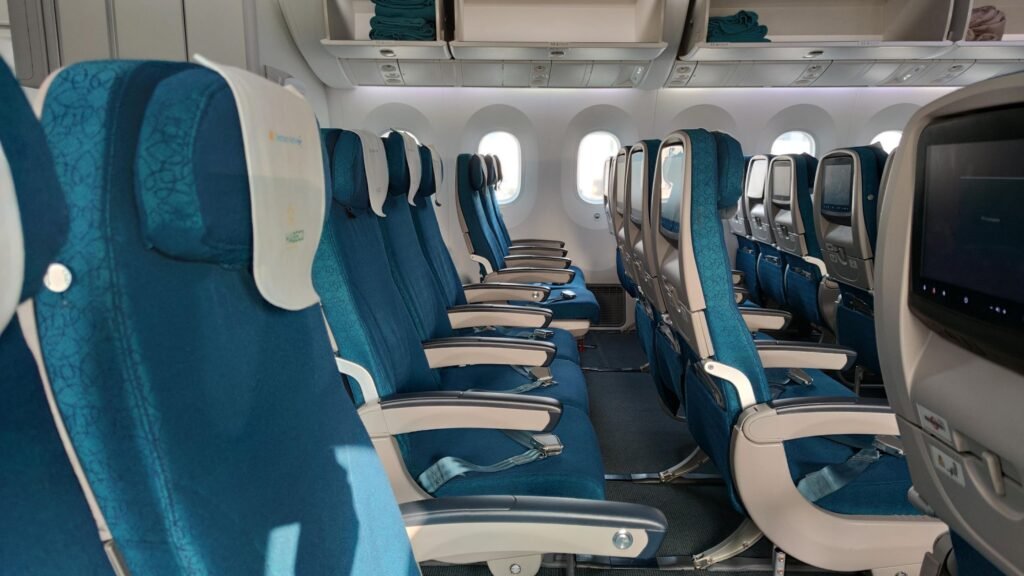
In premium economy, you usually get a wider recliner in a 2‑4‑2 or 2‑3‑2 layout on widebodies. In business class, many airlines now fly 1‑2‑1 pods with direct aisle access for every seat. Some aircraft still feature 2‑2‑2 or 2‑3‑2 in business; these can reduce privacy and require stepping over a neighbor. Because layouts vary by airline and aircraft, verify yours before you book.
Seat pitch, width, and recline: premium economy vs business class
| Measure | Premium Economy | Business Class |
|---|---|---|
| Pitch (legroom) | ~37–40 in | Varies; bed length often ~75–80+ in |
| Width | ~18–20.5 in | ~20–24+ in (seat) with more elbow room in pods |
| Recline | Deep recline + leg/footrest | Lie‑flat or angled‑flat to 170–180° |
Numbers vary widely and change over time as fleets refresh. Always confirm specs on the airline’s site for your aircraft.
Soft product in premium economy vs business class long haul
- Dining: Premium economy usually offers a step up from economy with upgraded entrees and presentation. Business class typically serves multi‑course meals, higher‑quality wines, and plated service.
- Drinks: Expect a broader selection in business class, sometimes with signature cocktails or championed producers. Premium economy may include welcome drinks and a better list than economy.
- Amenities: Premium economy kits vary; blankets and pillows are thicker. Business class kits and bedding are typically robust, with mattress pads on some airlines.
- Service ratios: Business class crews usually manage fewer passengers per flight attendant, which can translate to faster, more personalized service.
Hence, if elevated dining and a calmer experience are your main goals in premium economy vs business class long haul, both cabins will improve your trip; business class simply goes further.
Ground experience for premium economy vs business class long haul
Premium economy often includes priority check‑in, earlier boarding groups, and sometimes priority bags. However, lounge access is usually not included unless you have status or buy entry. Business class typically includes lounge access, priority lanes, and higher baggage allowances, all of which cut stress and save time. Meanwhile, these ground perks can be the deciding factor on tight connections or peak travel days.
Cost bands by region: premium economy vs business class
Price gaps vary by route, season, and competition. However, some patterns can guide a first pass before you dive into dates.
- Transatlantic (economy baseline = 1×): premium economy often 1.6–2.8×; business class often 3.8–6.5×.
- Transpacific: premium economy often 1.8–3.2×; business class often 4.5–8×.
- Intra-Asia and Middle East long haul: premium economy availability is uneven; business fares can be more competitive when airlines fight for share.
These are directional ranges pulled from typical published fares over time, not guarantees. Therefore, always check your exact dates. When comparing premium economy vs business class long haul, let the actual fare gap—and your sleep plan—lead the decision.
Fare rules and flexibility in premium economy vs business class long haul
Rules matter because they control risk and change options. When comparing premium economy vs business class long haul, fare classes and flexibility often diverge in ways that change value.
- Refundability: Fully flexible business fares are more common than fully flexible premium economy. However, both cabins may offer nonrefundable sale fares.
- Change fees: Many international fares allow changes for a fee plus any fare difference. Yet specific rules depend on the ticket brand and route.
- Same-day changes: Eligibility and cost vary widely. Moreover, same-day moves usually follow inventory rules, not just seat availability.
- Upgrade eligibility: Some premium economy fare classes are not upgradeable with miles; others are. Check the fare basis code before you book.
- Protection during irregular operations: Rebooking priority can correlate with cabin and fare class. Consequently, higher cabins may rebook faster when seats are scarce.
Airlines to study for premium economy vs business class long haul
Use official pages to verify what flies on your route right now:
- British Airways World Traveller Plus (Premium Economy)
- British Airways Club World (Business Class)
- American Airlines Premium Economy
- Singapore Airlines Business Class
- United Polaris Business
| Airline | Premium Economy Example | Business Class Example |
|---|---|---|
| British Airways | World Traveller Plus recliner | Club Suite with door (A350/777 retrofit) |
| American Airlines | Premium Economy recliner on 777/787 | Flagship Business lie‑flat pods |
| Singapore Airlines | Premium Economy recliner on A350/777 | Business Class lie‑flat; many 1‑2‑1 pods |
| United | Premium Plus recliner | Polaris lie‑flat with Saks bedding |
These labels and layouts can evolve; use the links above to confirm your exact aircraft and cabin before booking.
Pricing and upgrade math: premium economy vs business class long haul
Instead of chasing sale headlines, anchor your choice with a simple model. Start with your route and timing, then layer in the price or points gap. Finally, add ground perks that save you time.
| Criterion | Premium Economy Score | Business Class Score |
|---|---|---|
| Sleep need (none/nap/full) | 1–2 | 2–3 |
| Route timing (day/red‑eye/ultra) | 1–2 | 2–3 |
| Privacy need (low/med/high) | 1–2 | 2–3 |
| Price gap (large/small) | 3 if gap is large | 3 if gap is small |
| Ground time saved (low/high) | 1–2 | 2–3 |
| Work capability (email/laptop/calls) | 1–2 | 2–3 |
Set a personal threshold. For example, choose business class if it beats premium economy by 4+ points. Otherwise, pick premium economy or stay in economy if neither justifies the extra spend.
Points and miles for premium economy vs business class long haul
- Saver awards vs. Anytime: Saver space in business can be scarce on peak dates. If you see it on your route, it may be your best path to a bed at a sane cost.
- Cash + upgrade: Some programs let you buy a flexible premium economy fare and request a miles or cash upgrade later. However, upgrades clear by fare class and status, and they are never guaranteed.
- Partner awards: Alliances open access to partner space. Sometimes partners show award space your home airline app hides.
Because policies change, verify with your airline’s loyalty pages before transferring any points. In the context of premium economy vs business class long haul, the best value is often a discounted business class sale or a true saver business award on your preferred dates.
Route timing and jet lag in premium economy vs business class long haul
On daytime long-hauls, premium economy often wins because you can work, eat well, and arrive late afternoon without needing a full night of sleep. On red‑eyes, business class can buy you a functional next day. On ultra‑long routes over 13 hours, business class improves your odds of real rest and reduces body clock shock.
Traveler scenarios: premium economy vs business class
- Solo on business: If you must land ready for meetings, a lie‑flat seat reduces risk. However, a daytime flight in premium economy can work if meetings start the following morning.
- Couple on vacation: A daytime westbound often suits premium economy. Conversely, for short eastbound overnights, business class helps you salvage the first day.
- Family with kids: Premium economy’s pairs by the window can be ideal. Meanwhile, business class cabins may split families if you need multiple adjacent pods.
- Bleisure with checked samples or gear: Extra baggage in business class can simplify logistics. Even so, confirm the allowance because rules differ by fare brand.
Above all, match cabin to schedule. Then price the gap and decide whether sleep or space is the binding constraint.
Couples seating in premium economy vs business class long haul
In premium economy, 2‑3‑2 or 2‑4‑2 blocks create natural pairs by windows. Those can be ideal for couples who chat occasionally. In business class, some seats are designed as “honeymoon” pairs in the center; others angle away for privacy. Because layouts vary, study your seat map before choosing.
Work, connectivity, and power: premium economy vs business class long haul
Both cabins now usually include AC power and USB. However, business class tray tables and pod surfaces support laptops more comfortably, and many pods shield glare. Wi‑Fi pricing and speed vary by airline; some carriers comp messaging or sell flight passes. If you must work on board, consider how much elbow room and privacy you need.
Noise, lighting, and cabin environment
- Bassinet rows: Bulkheads can offer leg rests or larger monitors, but they may place you near bassinets. Therefore, weigh comfort against potential noise.
- Galleys and lavatories: Seats near service areas see more foot traffic. As a result, they can be brighter and noisier during meal services.
- Mini-cabins: Smaller sections in both cabins often feel quieter. However, they can book up early.
Health and recovery: premium economy vs business class long haul
Back support and sleep posture affect how you feel at immigration and at your first meeting or sightseeing stop. On overnight flights, the difference between a recliner nap and a true lie‑flat sleep can translate into fewer yawns, better hydration habits, and less neck stiffness. As a result, your first 24 hours may be more productive in business class.
Accessibility and mobility planning
If you need mobility or seating assistance, notify the airline early. Many carriers can arrange wheelchair support, pre‑boarding, or seat features like movable armrests in select rows. Because cabin layouts differ, confirm which seats allow easier access, and check lavatory proximity. In addition, allow more time for connections when relying on airport assistance teams.
Packing a personal comfort kit
- Neck pillow sized for a recliner if you choose premium economy; thinner pillows work better in pods.
- Moisturizer and lip balm, plus a small water bottle if permitted after security.
- Eye mask and earplugs; consider noise‑canceling headphones for galleys and bassinet areas.
- Light layers to adjust for cabin temperature swings.
- Sleep aids only as advised by your clinician; test at home first.
Even a small kit improves comfort, and it helps close part of the gap if you stay in premium economy.
Common mistakes in premium economy vs business class long haul
- Not checking the exact seat and layout for your flight number and date.
- Upgrading for lounge access alone when you could buy a lounge pass for less.
- Booking a good cabin on a poor schedule; arrival time can matter more than the seat.
- Ignoring the price gap; sometimes premium economy pricing is close to business in a sale—then the bed may be worth it.
- Forgetting baggage and change fee differences that can erase savings.
Therefore, always pair your cabin choice with smart timing and the actual benefits you will use. In short, treat premium economy vs business class long haul as a decision about sleep, time, and value, not status alone.
Quick answers on premium economy vs business class long haul
How much more space is there in premium economy?
Typically, several inches more legroom and a wider seat than economy, plus a leg rest or footrest. This can make a real difference on 8–10 hour flights, though it is not a bed.
Do all business class seats lie flat?
On most long-haul aircraft from major carriers, yes. However, a few configurations still use angled-flat or older layouts on select routes. Check your exact plane and seat map.
Is premium economy vs business class long haul mainly about sleep?
Sleep is the biggest divider, but not the only one. Business class usually adds lounge access, priority services, and more privacy, which may matter just as much on busy travel days.
How we built this premium economy vs business class long haul comparison
This guide focuses on features affluent travelers evaluate before booking: seat hardware, sleep, privacy, dining, ground benefits, and value. We point to official airline pages for current product details and avoid guarantees about upgrade space or future fleet changes.
Watch: premium economy vs business class insights for long haul
If the embed does not load, you can open the video here: The TRUTH About PREMIUM ECONOMY.
When to book which cabin for premium economy vs business class long haul
- Day westbound, 6–10 hours: Premium economy usually wins. Work, movie, a nap, enjoy dinner, arrive ready for a normal evening.
- Overnight eastbound, 7–9 hours: Business class pays off. You can eat early and sleep flat for 4–6 hours, then land near‑normal.
- Ultra‑long, 13+ hours: Business class strongly preferred if the price gap is reasonable for your budget.
- Short red‑eye, 5–7 hours: Consider business or a premium economy bulkhead if business is priced very high.
Because your schedule matters more than distance alone, decide where you plan to sleep—on the plane or on the ground—and choose the cabin that supports that plan. This is the core of deciding premium economy vs business class long haul wisely.
Seat map traps and aircraft changes to watch
- “1‑2‑1” does not always mean the same seat. For instance, some pods are narrower near the feet. Meanwhile, others have doors.
- Older 2‑2‑2 business layouts often remove direct aisle access. Therefore, window seats may require stepping over a neighbor.
- Premium economy bulkheads can deliver leg rests or extra space, yet IFE screens may be on arms, reducing width.
- Equipment swaps can change seat types. Consequently, set alerts for schedule changes and re‑check maps after each update.
What to book first in premium economy vs business class long haul
- Pick flight times that fit your body clock and meetings.
- Confirm the aircraft and seat model in your target cabin.
- Track prices or award space for a few days; set alerts if helpful.
- Book when the gap between premium economy and business aligns with your threshold.
Plan next steps for premium economy vs business class long haul
Also consider your hotel and transfers at the same time you choose your cabin. Coordinating arrival time with early check‑in, lounge showers, or a day room can smooth recovery even if you pick premium economy over business. Likewise, if you choose business class, plan to maximize rest by dining early and sleeping straight after takeoff.
Compare flights for premium economy vs business class long haul
Affiliate disclosure: Some links in this luxury travel guide may be affiliate links. If you book or buy through them, Silk Harbor Travel may earn a commission at no extra cost to you.
Ready to compare seats, schedules, and fares across airlines? Use this link to review cabins, then filter for the aircraft and layout you want:
Compare long‑haul premium cabins on Trip.com
Use filters for departure time, flight duration, and aircraft model to quickly zero in on the best options for your premium economy vs business class long haul decision.
More luxury travel guides for planning your trip
FAQ: Premium economy vs business class long haul
Does premium economy include lounge access?
Usually not. Some airlines allow paid lounge entry or grant access if you hold elite status. Business class typically includes lounge access.
Which cabin has better baggage benefits?
Business class often includes a more generous checked baggage allowance and priority tags. Premium economy improvements vary by airline and fare.
Is the food really different?
Yes. Premium economy meals are generally a step up from economy. Business class aims for a restaurant‑like service with more courses and better beverage lists.
What if the aircraft changes?
Aircraft swaps happen. If a change affects your seat type, contact the airline to re‑select seats or discuss options. Policies vary by carrier.
Can I upgrade from premium economy to business at the airport?
Sometimes. Same‑day upgrades may be offered for cash or miles based on availability and fare class. Offers are not guaranteed and differ by airline.
Finally, make your choice with confidence. Align your route and sleep plan with the real features you will use, and the right answer for premium economy vs business class long haul becomes clear.