

Published
Quick answer: Verify Royal Caribbean suite perks against the exact ship, sailing, cabin category and booking terms. A room name, attractive photograph or broad tier label is not enough to complete that check. Build a short record of the benefits that matter to your party, save the applicable wording and ask about unresolved exceptions before paying for an upgrade.
A suite comparison can look straightforward until two pages describe the same benefit differently. One page lists a tier’s headline features; another adds category exceptions. A third screenshot, shared by a traveler, may concern a different sailing entirely. The useful question is narrower than “What does a suite include?” It is “What can these named guests expect with this particular reservation?”
This guide is a booking-verification worksheet for Royal Caribbean, not an all-line suite ranking. It helps you separate a room’s identity from its benefits, record conditions without losing them and prepare specific questions for the cruise line or your booking adviser. The examples are fictional planning exercises. No cruise, room inspection or onboard service test was conducted for this article.
Free download: Luxury Trip Planning Checklist
Shortlist premium stays faster with a calm, high-signal checklist.
Source note: Royal Caribbean’s official category and benefit FAQs were checked on November 22, 2026. They contain exceptions and wording that may change. Confirm the terms applying to your reservation; this article is not a replacement for them.
Which Royal Caribbean suite perks come with Sea, Sky and Star?
The official category FAQ divides Royal Suite Class into Sea, Sky and Star. Its examples place a Junior Suite in Sea, a Grand Suite–1 Bedroom in Sky and a Royal Loft Suite in Star. It also places Sky Junior Suite and Sunset Junior Suite in Sky, demonstrating why shortened room names are unreliable. Categories vary by ship, and the page warns that categories can change. Use its actual category list rather than inferring a tier from the word “suite.”
The official benefits FAQ describes Sea’s Coastal Kitchen dinner access as reservation-dependent and subject to availability. Sky lists concierge, lounge and sun-deck benefits, with category exceptions to internet inclusion. Star includes Royal Genie service and many dining benefits, but chargeable dining exceptions remain. Genie service does not extend to companions who are not booked as Star guests. Included gratuities have a stated scope; they are not a blanket description of every possible tip.
One issue deserves explicit confirmation: the category FAQ excludes VOOM for Sky Balcony, while the benefits FAQ gives Spectrum’s Sky Balcony (BY) a booking-date exception for reservations made on or before April 27, 2026. Those statements do not settle an individual reservation. Ask Royal Caribbean which provision applies and retain its response.
Start with a reservation identity card
Create a separate card for each option you are genuinely considering. Copy the ship name, departure date, duration, passenger count, exact cabin category wording and category code from the quote. Add the cabin number if one is specified. If a cabin assignment is unknown, write that down instead of borrowing a number from an example photograph.
The card should also identify the quote itself. Save the date you obtained it, the quoted currency, the seller and any reference number. Two browser tabs can describe different offers even when their headings look similar. A recognizable filename, such as ship-date-category-quote-date, makes it easier to recover the right document later.
Keep the names and travel details of your party in a private booking record. A comparison worksheet shared casually with friends does not need passport numbers, account credentials or full reservation identifiers. You can discuss the decision using anonymous labels while keeping the official documentation in the appropriate account or booking correspondence.
If you are comparing a room for two with a room for three, flag that difference immediately. Your goal is not to make the prices look comparable by averaging them differently. It is to identify which offer accommodates the actual party and what that offer includes. Leave a mismatched option outside the final comparison until its scope is corrected.
Build a table of the perks that matter to you
| Field | What to record | Why it helps |
|---|---|---|
| Exact reservation | Ship, date, party, category and cabin if assigned | Keeps the answer attached to the offer you may buy |
| Benefit question | One specific entitlement or condition | Avoids vague requests about “everything included” |
| Evidence | Official URL, saved quote or written response | Lets you revisit the actual wording |
| Qualification | Availability, guest scope, timing or stated exception | Prevents the headline from losing its conditions |
| Decision status | Confirmed, conditional, not included or unresolved | Makes uncertainty visible before payment |
| Personal importance | Essential, useful or unlikely to use | Separates your priorities from the marketing list |
| Next action | Who will answer which remaining question | Turns a comparison into a manageable task |
Give each important benefit its own row. A single cell saying “dining” can conceal several different questions about venues, meals, bookings and charges. Your row might instead ask whether the specific meal you intend to arrange is covered under the quoted terms. The answer belongs beside that question, not beside a broader claim about dining in general.
Use “unresolved” as an ordinary status. It is not a negative review of a product. It means that the information currently in your possession does not answer your particular question. That distinction makes it easier to seek clarification without accusing a seller of withholding something that may simply have been omitted from a summary.
Separate eligibility, access and a confirmed arrangement
There are three different planning questions: are you eligible for a benefit, what conditions govern using it, and have you actually arranged the experience you want? Treat these as separate fields even when the booking page presents them together. A benefit description is useful evidence for the first question; it may not answer the other two.
For example, a fictional couple might care about one anniversary dinner at a particular time. Their worksheet should name that objective. A general entry saying “special dining included” does not show whether their preferred arrangement is available. They should ask the precise question while they still have a choice between offers.
Distinguish your preferred plan from a requirement. If you would happily choose another time, record that flexibility. If the trip is worthwhile to you only with a particular arrangement, record the issue as essential and unresolved until you have an applicable answer. Do not quietly convert a preference into an assumed promise.
This method also keeps a comparison fair. An option should not receive credit for an arrangement you have merely imagined while its competitor is judged only on documented details. Apply the same evidence standard to both, including the option whose photographs you prefer.
Write questions that can receive useful answers
A productive request contains enough information for the adviser to identify the offer, but only one or two questions at a time. “Are all perks included?” invites a broad response. “For this ship, date and category, which rule governs the internet benefit on our booking?” identifies something that can be checked.
Here is an original message template: “We are comparing [ship and date], for [party size], in [exact category and code]. The offer reference is [reference]. We need to confirm [specific benefit]. The page at [URL] says [brief description], while [other document] appears different. Which terms apply to this reservation, and what conditions should we retain with the quote?”
Ask for clarification in the same context as the booking rather than sending a disconnected question about a tier name. If a response discusses a different ship or omits the category, politely restate the details. A response that is friendly but not tied to your offer may still leave the decision unresolved.
Record the date and channel of the answer. Keep the original response rather than relying only on your own summary. Your notes can explain why the answer matters, but they should not replace the wording you received or add a guarantee the adviser did not make.
Check the whole party before planning shared experiences
A group trip needs a guest-by-guest record. List the cabins being considered and who will stay in each. Then identify which activities the group expects to do together. This is a planning exercise, not a claim that one guest’s room automatically determines what anyone else may use.
Mark each shared activity with three questions: what does each reservation include, what still needs arranging, and is there an acceptable alternative if the group cannot use the same arrangement? Do this before treating a premium cabin as the centerpiece of everyone’s holiday.
Consider a fictional family booking two different categories. One household values additional room space; the other prefers to spend more on excursions. Their priorities can coexist. The useful conversation is about the parts of the trip they want to share, rather than pressuring both households to purchase the same option merely to simplify a spreadsheet.
If the group’s plan depends on an entitlement that has not been confirmed for everyone, keep that dependency visible. An expensive purchase is a poor way to test an assumption after the fact. Either obtain the applicable answer or design the shared plan around something all parties have independently confirmed.
Keep cabin suitability separate from benefit verification
The benefit table does not replace a room review. Create a second, shorter list for the physical cabin: sleeping arrangement, bathrooms, balcony description, location and any accessibility needs. Use the documents for the actual category and assigned cabin where available.
Do not let one attractive service feature answer an unrelated room question. If someone needs a particular bed arrangement, a confirmed benefit elsewhere in the package does not resolve that requirement. Similarly, a spacious-looking photograph cannot establish dimensions or accessibility details for the room being quoted.
For a broader discussion of position and surrounding spaces, use our cruise cabin location guide. This article keeps the focus on matching benefits to the reservation, so the two checks remain distinct and easier to complete.
A useful final comparison has two independent conclusions: “This room suits our party” and “We understand the applicable benefits.” If either conclusion is missing, explain what remains unresolved. The strength of the other conclusion should not hide the gap.
How do you compare the price of a suite upgrade?
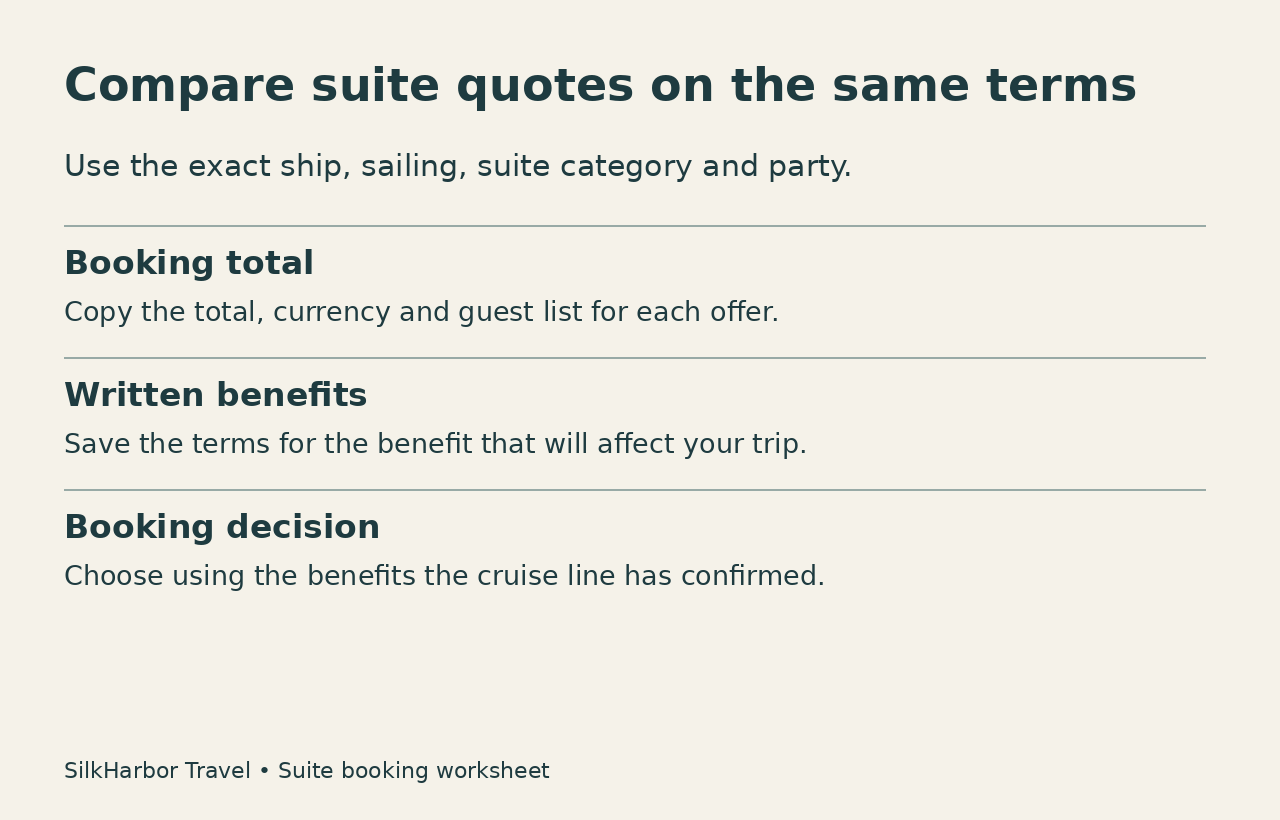
Example Imagine comparing cabins on the same sailing. Save written quotes for the same travelers and currency. Check that each quote names the ship and suite category you actually want. Copy the whole booking total exactly as displayed. If one quote lists a price per guest, ask for its full booking total before comparing the offers.
| Field | What to verify |
|---|---|
| Booking total | Match sailing, dates, guests and currency. |
| Benefit you value | Record the wording for your ship and suite category. |
| Decision | Choose the offer you would book using confirmed benefits. |
Mark each benefit as essential, useful or unlikely to affect the trip. Keep a separate line for anything still awaiting confirmation. Compare each offer against the spending limit you would be comfortable with for the whole reservation. Leave unpriced features in the benefit column.
Ask your travel partner which difference would actually change the trip. If you want to eat at a particular time or share an activity with friends in another room, write that down. Ask the cruise line or your booking adviser whether the exact arrangement is available for the named guests, ship and sailing.
Keep the inquiry with the quote. Read the cancellation conditions again if you change categories. When the answer about an essential benefit is unclear, compare the offers on what is confirmed and decide whether you would still choose the upgrade.
Use the luxury cruise total-cost guide to record expenses that sit outside either cabin quote.
Three booking situations and the evidence each needs
A first-time suite buyer with a short list of priorities
In this fictional case, a pair wants a quiet place to plan the day and help arranging a celebration. They begin with those objectives rather than a list of every amenity they have seen online. Each objective becomes a question for the exact offer under consideration.
Their completed worksheet might still contain several benefits marked “unlikely to use.” That is useful information, not a failure to appreciate the package. It prevents an impressive list from overpowering the two things that actually motivated the purchase.
Returning guests who remember a previous sailing
A fictional returning guest remembers an enjoyable arrangement from an earlier trip. They write that memory in a background note, with the old ship and date if known. They do not place it in the evidence column for the new reservation.
The new decision starts with current documents. Where the guest hopes to repeat something, they ask about it explicitly. This preserves the value of personal experience as a source of questions while preventing an old experience from becoming an unsupported claim about a new offer.
A group whose preferred cabins have different terms
A fictional group of four adults is considering two cabins. Each pair completes its own reservation card, then the group lists the activities everyone wants to share. They seek answers only for the points where those plans depend on the cabin terms.
This produces a shorter and more useful discussion than comparing every possible amenity. They can accept different room choices while resolving the specific uncertainties that could affect the shared trip. No one is asked to pay for a benefit merely because another pair values it.
What to save before accepting an offer
Keep the final quote, exact category description, relevant benefit pages and any written clarification together. Include the date you saved each item. A folder with a few well-labeled files is more useful than dozens of screenshots whose ship, offer or timing cannot be identified.
Add a one-paragraph decision note in your own words: the offer chosen, the reasons, the material conditions you understand and any remaining uncertainty you are willing to accept. This note records your reasoning; it does not create new contractual terms or replace the booking documents.
If an adviser changes the offer, compare the revised version against the original identity card. Check what changed rather than assuming the revision affects only price. Update the worksheet so that it describes one coherent offer, not favorable details collected from several different versions.
Keep payment and cancellation questions in the booking record as well, using the terms supplied for your actual purchase. This guide supplies no general refund or change-policy promise. If those terms influence your choice, resolve them with the seller before accepting the offer.
Copy this booking comparison into your own notes
The table below is deliberately blank. It is a place to record your own evidence, not a list of promised Royal Caribbean inclusions. Complete one row at a time using the exact quotes you are comparing. If a question does not matter to your party, mark it “not a priority” rather than researching it simply because a box exists.
| Question | Offer A: evidence and conditions | Offer B: evidence and conditions | Next action |
|---|---|---|---|
| Exact ship, date, category and party? | Enter from quote | Enter from quote | Resolve any mismatch |
| Total price for the same scope? | Amount, currency and quote date | Amount, currency and quote date | List what each total excludes |
| Room arrangement meets our needs? | Document and remaining question | Document and remaining question | Confirm essential physical requirements |
| Our most important benefit? | Exact condition and source | Exact condition and source | Ask about the unanswered point |
| Our preferred shared activity? | Which guests, which arrangement? | Which guests, which arrangement? | Verify each affected reservation |
| What could change our choice? | Material uncertainty | Material uncertainty | Resolve before deciding |
Here is a fictional completed note for the final row: “We prefer B only if our essential requirement is confirmed. Our current record has no applicable answer, so our decision remains open.” That is more informative than assigning B a high score because its photographs look attractive. The note separates a preference from the evidence needed to act on it.
After receiving an answer, append a dated update instead of deleting the original question. For example: “Question resolved by the booking adviser’s written reply saved in our private folder; see the exact conditions there.” Do not write “guaranteed” unless the actual document supports that wording. This small habit makes the worksheet useful when you return to the decision days later.
You can print this section or copy the rows into a document. Leave enough space to retain the qualifications alongside each answer. If you need a second page, use one; squeezing the notes into an unreadable screenshot defeats the purpose of collecting them.
A final five-minute review
- Read the reservation card aloud. Confirm the ship, date, party and exact category match the offer you intend to accept.
- Review essential rows first. Identify any unresolved question that could change your decision.
- Read the conditions beside each answer. Do not carry only the benefit headline into your final notes.
- Check room suitability separately. Make sure the physical arrangement meets the party’s needs.
- Save the evidence and decision. Keep the documents that support the choice in one place.
Take longer if a material answer is missing. Five minutes describes a final review of completed research, not a deadline for purchasing. A pause to clarify a consequential question is more useful than a perfectly formatted comparison built on an unresolved assumption.
After booking, keep the same record available when reviewing later correspondence. If a detail appears different, identify the specific wording and ask about it. Avoid silently replacing the original evidence with a new screenshot and losing the context of the question.
Frequently asked questions
What should I check first?
Identify the exact reservation before comparing benefits: ship, sailing date, party and category. Without those details, an answer may concern a different offer. Then list the few benefits that could genuinely change your choice.
Can I decide from the room name alone?
Use the full name and category code as starting information, then match them to the official documentation and quote. A shortened label in a conversation is not a complete booking record.
What if two official pages appear inconsistent?
Save both URLs, record the relevant difference and ask which terms apply to your reservation. Leave the issue unresolved until you receive an applicable answer; do not choose whichever interpretation makes the offer look better.
Should every listed perk receive a dollar value?
No. A personal preference is not a documented cash saving. You can label a benefit useful or essential without inventing a retail price. Compare the real difference between equivalent quotes with your own spending limit.
What if I am traveling with people in other cabins?
Keep a separate card for each reservation and verify the conditions of the activities you want to share. The group’s plan should rest on confirmed information for the relevant guests, not an assumption that one booking covers everyone.
Does this worksheet prove that an upgrade is worth it?
It helps establish what you know, what remains uncertain and how the choice fits your priorities. It cannot decide your preferences, guarantee an experience or turn an unresolved term into a confirmed benefit.