

If you are comparing brands before a premium city stay, resort week, or milestone trip, this guide breaks down luxury hotel loyalty perks in buyer language rather than points-forum language. The goal is simple: decide which benefits really improve the stay, which ones sound better than they feel, and when it is smarter to use a premium booking channel instead of chasing status.
Luxury travelers usually care less about abstract point balances and more about friction. Will breakfast actually save time? Will the upgrade change the room in a meaningful way? Will late checkout let you keep a spa slot, a meeting, or one more swim without booking another night? Those are the questions that matter. Therefore, the best way to judge luxury hotel loyalty perks is to measure how each one changes the trip hour by hour.
Key takeaways before you chase hotel status
- Breakfast, late checkout, and strong upgrade odds usually create more real-world value than point-earning rates alone.
- Not every “upgrade” is meaningful. A higher floor or marginally better view may matter less than lounge access, a suite, or a later departure.
- The strongest programs are not identical. Marriott is powerful on late checkout. Hyatt is strong on breakfast and suite-style value at the top tier. Hilton can work well on breakfast or food-and-beverage value. IHG is more nuanced unless you lean on Diamond or InterContinental Ambassador benefits.
- Premium booking channels such as Amex Fine Hotels + Resorts or Capital One Premier Collection can beat loyalty on one-off luxury stays because they deliver breakfast and credits without long-term commitment.
- The smartest move is often to avoid double counting. If your rate already includes breakfast or your booking channel already gives a credit, the loyalty perk may not be worth paying extra to earn.
What do luxury hotel loyalty perks usually include?
Most travelers hear “elite benefits” and think points, but the most useful perks are operational. They improve arrival, the room itself, the daily dining rhythm, and departure timing. In luxury travel, those changes can be worth far more than the rebate logic that points enthusiasts focus on.
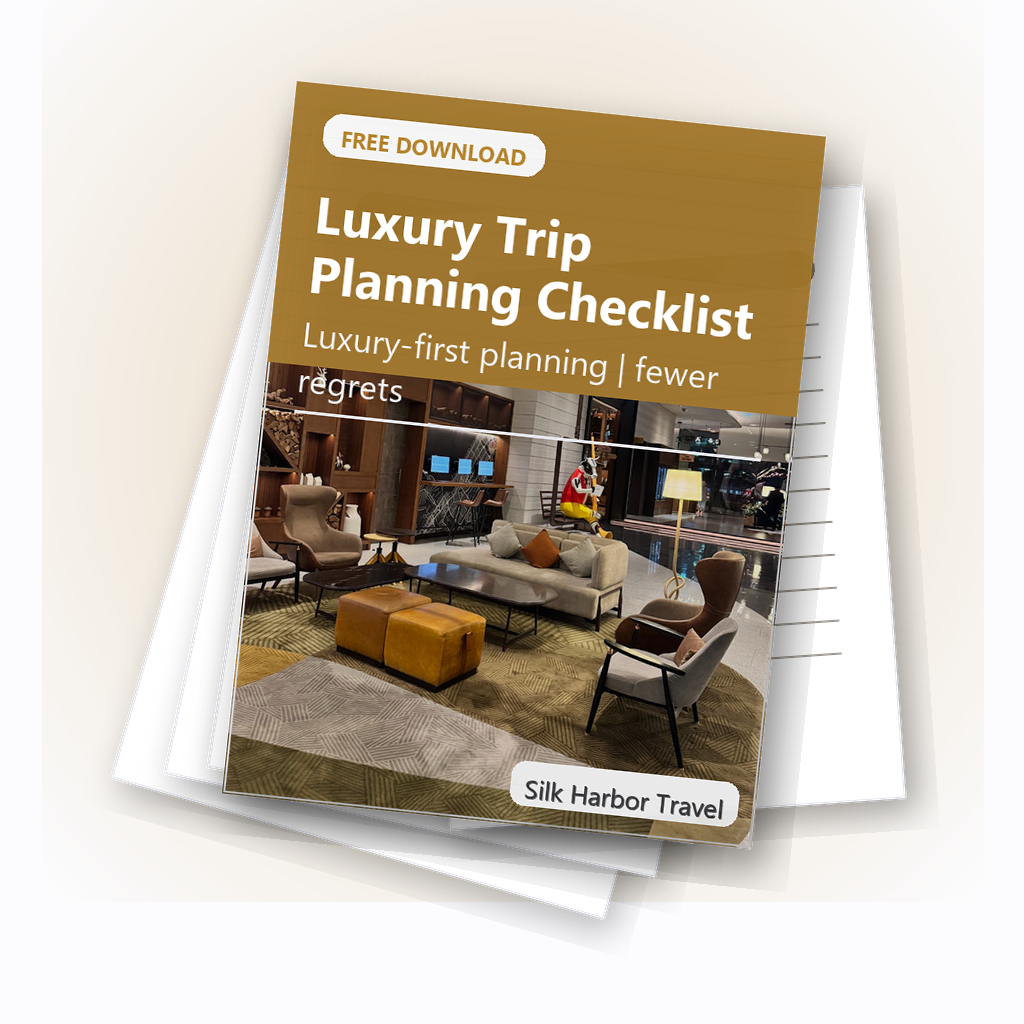
Free download: Luxury Trip Planning Checklist
Shortlist premium stays faster with a calm, high-signal checklist.
| Perk type | What it changes | Why luxury travelers care |
|---|---|---|
| Breakfast | Daily out-of-pocket cost and morning convenience. | Luxury hotel breakfasts are often expensive enough that free coverage materially changes trip value. |
| Room upgrades | Space, view, privacy, or lounge access. | A meaningful upgrade can improve every hour you spend in the hotel. |
| Credits | Dining, spa, or property experience spending. | Credits are strongest when they offset charges you would genuinely make anyway. |
| Late checkout | Departure friction and final-day flexibility. | For long-haul departures, evening flights, and spa-heavy itineraries, this can be one of the highest-value perks on the page. |
| Lounge access | Breakfast, snacks, drinks, and a quiet work or reset space. | Lounge access often behaves like a hybrid of breakfast, convenience, and soft savings. |
| Bonus points | Future redemption value. | Useful, but usually less tangible than the perks you feel during the stay itself. |
That distinction matters because the best loyalty strategy is rarely “pick the biggest number.” Instead, it is “pick the program whose usable perks match the kind of luxury stay you actually book.”
Which hotel programs have the most usable luxury hotel loyalty perks right now?
Official benefit language changes, and property-level execution matters. Still, a few patterns are consistent enough to shape booking decisions with confidence.
Quick comparison of luxury hotel loyalty perks by program
| Program or channel | Breakfast value | Upgrade value | Late checkout | Credit angle |
|---|---|---|---|---|
| Marriott Bonvoy Platinum+ | Lounge breakfast at participating hotels. | Enhanced room upgrades. | 4 p.m. checkout at many hotels; resort exceptions matter. | Mainly status-led, not credit-led. |
| World of Hyatt Globalist | Club breakfast or breakfast alternative. | Strong top-tier suite-style value. | Strong 4 p.m. language, with participation notes. | No universal property credit. |
| Hilton Honors Gold/Diamond | U.S. F&B credit or breakfast abroad at select brands. | Useful space-available upgrades. | Late checkout by request; 4 p.m. guarantee sits higher. | Flexible food-and-beverage value. |
| IHG One Rewards Diamond | Free hot breakfast at participating brands. | Useful but less defining at the luxury end. | Up to 2 p.m., subject to availability. | Heavily brand- and property-dependent. |
| InterContinental Ambassador | Not mainly a breakfast play. | Useful within the InterContinental ecosystem. | Guaranteed 4 p.m. late checkout. | Dining/bar credits up to USD20 per stay. |
| Amex Fine Hotels + Resorts | Daily breakfast for two. | Arrival-day upgrade when available. | Guaranteed 4 p.m. late checkout. | US$100 experience credit. |
| Capital One Premier Collection | Daily breakfast for two. | Upgrade and timing perks when available. | Availability-based, not guaranteed. | Property credit up to USD100. |
Where hotel status is strongest
The immediate takeaway is that status and booking channels solve slightly different problems. Status helps repeated direct bookers. It is strongest when you stay often enough to use breakfast, late checkout, and upgrades several times each quarter.
Where premium channels are stronger
Premium booking channels help travelers who want elite-style treatment on a smaller number of luxury stays. In that case, luxury hotel loyalty perks still matter, but they may be easier to buy than to earn.
Is free breakfast one of the most valuable luxury hotel loyalty perks?
Often, yes. Not because breakfast is emotionally exciting, but because it compounds. A strong hotel breakfast for two at a luxury property can be expensive, and the convenience is real on slow resort mornings, early business days, or departure days with limited flexibility. Therefore, breakfast is usually one of the easiest perks to value honestly.
However, the form of the perk matters. Hyatt Globalist-style breakfast or lounge access can feel clean and high-value because it is easy to use. Hilton’s daily food-and-beverage credit can be more flexible in the U.S. Yet it only works if the credit amount matches your real breakfast habit and the brand participates in the way you expect. Marriott lounge-linked breakfast is powerful at participating properties. Still, it is less universal than many travelers assume. That is why breakfast should be priced by hotel and trip shape, not by brand reputation alone.

When breakfast is a big win
- You are staying three nights or longer at a resort or city hotel with a high breakfast check.
- You prefer to eat on property instead of hunting for a nearby cafe every morning.
- You are traveling as a couple or family, so the benefit multiplies across guests.
- You are using the stay as a true reset and want the ease of walking downstairs without planning.
When breakfast is less valuable than it looks
- Your rate already includes breakfast.
- You routinely skip breakfast or only take coffee.
- The breakfast benefit is a small credit that does not cover the real on-property cost.
- You are in a destination where local breakfast options are part of the trip you actually want.
Therefore, breakfast is not automatically “best.” It is best when it fits how you travel and when the hotel’s version of the perk is generous rather than symbolic.
Do room upgrades actually change the stay, or are they mostly marketing?
This is where many loyalty programs create more excitement than certainty. Most upgrade language still revolves around availability at check-in. In practice, property occupancy, brand rules, and the hotel’s willingness to release better inventory matter as much as your status card. Even so, upgrades remain one of the highest-potential luxury hotel loyalty perks because a meaningful room move can change every part of the stay.
The key word is meaningful. A better floor or slightly improved view is nice, but it may not justify loyalty devotion on its own. A true suite move, club-access room, larger terrace, or quieter corner room is a different story. That is why Hyatt’s top-tier suite-oriented value feels strong to many luxury travelers. Meanwhile, Marriott and Hilton can both be excellent when the property has generous upgrade inventory and a front desk that actually uses it.
| Upgrade type | Usually worth caring about | Often low-impact |
|---|---|---|
| Standard room to standard suite | Yes, especially on longer stays or work-plus-leisure trips. | Rarely low-impact if the suite adds real living space. |
| Standard room to club-access room | Yes, if breakfast, lounge snacks, and a quiet work area suit the trip. | Lower value if you barely use the hotel during the day. |
| Garden view to partial ocean view | Sometimes, when the room is a major part of the vacation. | Often minor on short stays or busy itineraries. |
| Higher floor or slightly better location | Useful for noise control or a cleaner layout. | Often more cosmetic than transformational. |
That means the right question is not “Do upgrades exist?” It is “How often do they become the kind of upgrade I would otherwise pay cash for?”
Which late-checkout perks are strong enough to plan around?
Late checkout is often the quiet hero of luxury hotel value because it protects the final day. It lets you keep a lunch reservation after the pool, shower before a night flight, or preserve a work block without hiding in the lobby. In premium travel, those hours can feel more valuable than another small points bonus.
Marriott stands out here because Platinum-level and above benefits include a 4 p.m. late-checkout promise at many properties, even though resort and convention-hotel carve-outs still matter. Hyatt’s upper-tier late-checkout value is also strong, but you still need to read the participation and availability notes. Hilton’s standard late checkout is useful by request. It is less of a planning-grade promise unless you are at the newer Diamond Reserve layer. IHG’s standard late checkout can help. However, an InterContinental Ambassador stay is where the late-checkout proposition becomes distinctly more powerful because the program advertises a guaranteed 4 p.m. departure.
As a result, travelers with evening departures, spa-heavy itineraries, or same-day meeting schedules should rate late checkout as a primary perk rather than a nice extra. It frequently saves the cost, annoyance, or awkwardness of a day-use room workaround.

Are property credits better than elite status on one-off luxury stays?
Are property credits better than luxury hotel loyalty perks on one-off stays?
Often, yes. This is the section many travelers miss. If you only book a few luxury hotels per year, chasing elite status can be less efficient than booking through a channel that already bundles breakfast, a room upgrade path, and a usable on-property credit. That is why Amex Fine Hotels + Resorts and Capital One Premier Collection matter in this conversation.
When property credits clearly win
Amex Fine Hotels + Resorts is especially compelling because its official benefit package includes breakfast for two, a US$100 experience credit, and guaranteed 4 p.m. late checkout. That stack can outperform mid-tier status in a single trip. Capital One Premier Collection is also attractive because it offers breakfast for two, a property credit, and availability-based upgrade and late-checkout benefits.
If you are booking one celebratory stay, one short city break, or one aspirational resort, these channels can be more pragmatic than committing a whole year to a brand you may not otherwise prefer. In that context, luxury hotel loyalty perks still matter. They just may not be the best primary tool.
When property credits are weaker than they look
However, property credits only count if you would use them anyway. A spa credit at a hotel where you never intended to book treatment is not real value. A dining credit that excludes the venue you actually want is also weaker than it first appears. Credits work best when they offset charges you already planned to make.
| If your trip looks like this | Status usually wins | Booking channel usually wins |
|---|---|---|
| You stay with one brand repeatedly all year | Yes, because repeat usage compounds breakfast, upgrades, and checkout benefits. | Less often. |
| You want one luxury stay with maximum perks and no status grind | Usually not. | Yes, especially with FHR-style benefits. |
| You already have base or mid-tier status but want a stronger one-off package | Partly. | Often yes, if the credit and guaranteed checkout are strong. |
| You need guaranteed-style departure flexibility | Sometimes, depending on brand tier. | Strong when the channel gives 4 p.m. checkout outright. |

Should you chase status or buy perks as needed?
The right answer depends on frequency, not aspiration. If you naturally stay enough nights with one brand to earn meaningful status, then status is often worth leaning into. You will use breakfast, late checkout, and upgrade benefits repeatedly, and the value becomes easier to defend. If your luxury stays are occasional and spread across brands, buying perks through premium channels is often more rational. It also prevents you from forcing loyalty behavior that does not match your real travel pattern.
LOYALTY PERK DECISION FLOW
DO YOU STAY OFTEN?
Repeat nights create status value
WHICH PERK MATTERS MOST?
Breakfast, suite, credit, or checkout
ONE STAY OR MANY?
One-off stays favor purchased perks
CHASE STATUS
Natural repeat stays
Direct booking habit
BUY PERKS
FHR or Premier Collection
Best for one-off luxury trips
CHECK DOUBLES
Do not count breakfast twice
Compare only marginal value
For many Silk Harbor readers, the practical answer is mixed. Keep one primary program for repeat direct stays. Then use a premium booking channel for occasional luxury hotels where the bundled breakfast, guaranteed late checkout, or property credit is clearly stronger than your current status.
How do you avoid double counting hotel perks?
This is one of the easiest ways to make a bad booking decision. A traveler may count breakfast through status, then count it again through the paid rate, then count a lounge benefit as extra even though it replaces the same breakfast value. Similarly, a traveler may book through a premium channel with a dining credit, then overvalue a hotel-program credit that can only be used in the same outlets.
To fix that, compare only the marginal value. Ask four questions. First, what do I get on the cheapest acceptable rate? Second, what do I gain if I book direct and rely on status? Third, what do I gain if I book through a premium channel instead? Fourth, which choice changes the trip the most after removing duplicate benefits? That four-step comparison is usually enough to keep the math honest.
What mistakes make luxury hotel loyalty perks feel worse than expected?
- Confusing “space available” with likely. Upgrades can be real and still remain inconsistent at high-occupancy luxury properties.
- Chasing breakfast when your travel style does not support it. If you skip breakfast or leave early most mornings, the perk is overrated for you.
- Ignoring resort carve-outs. Late-checkout language is often strongest on paper and more limited at resorts.
- Valuing credits you would not naturally spend. A spa credit is not meaningful if you never planned a treatment.
- Forgetting club access as a hybrid perk. Lounge access can sometimes replace breakfast, snacks, and a quiet workspace better than a nominal dining credit does.
- Staying loyal to a brand you do not even prefer. The best elite program is not helpful if it pushes you into weaker hotels for your actual trip goals.
Which travelers should care most about luxury hotel loyalty perks?
Frequent business and bleisure travelers
These travelers usually get the clearest value from late checkout, breakfast, elite check-in, and predictable direct-book benefits. Because frequency is high, even mid-tier perks compound fast.
Couples booking premium city weekends
For this group, breakfast and late checkout often matter more than raw point earnings. A two-night city stay can feel far more relaxed when the final day is not shaped by a noon departure.
Resort travelers and honeymooners
These travelers should care most about meaningful upgrades, breakfast, and any perk that protects arrival and departure flow. However, they should also compare status against premium booking-channel benefits because one-off luxury stays are where FHR-style packages can be strongest.
Low-frequency luxury travelers
If you only book one or two premium stays per year, elite status often makes less sense unless it comes through an existing card or very natural loyalty pattern. In that case, pay for the right room, use a premium booking channel when helpful, and skip the performance art of status chasing.
Hotel elite benefit comparison video
If the video does not load because of consent settings, watch it directly on YouTube here: Elite Benefit Battle: Marriott, Hilton, Hyatt, and IHG.
More luxury hotel guides for planning your trip
If you want to go deeper before you book, read Club Level Hotel Upgrade Worth It for lounge-value logic. Then read Five Star Resort Room Categories Explained for room-selection strategy. Finally, read Resort Dining Plan Value for another honest look at which hotel extras actually pay off.
FAQ: quick answers on luxury hotel loyalty perks
Which luxury hotel loyalty perks are the most valuable in real use?
Breakfast, late checkout, and meaningful room upgrades usually create the clearest day-to-day value because you feel them on every stay, not only when you redeem points later.
Is hotel elite status worth chasing only for free breakfast?
Usually only if you earn that status naturally or cheaply. Breakfast alone rarely justifies expensive mattress runs if your luxury stays are infrequent.
Are hotel upgrades guaranteed for elite members?
No. Most programs describe upgrades as space-available at check-in, so occupancy and property-level control still matter.
Which program is strongest for late checkout at luxury hotels?
Marriott Platinum and above are strong on paper because of 4 p.m. late-checkout language at many hotels, while Hyatt Globalist is also compelling. InterContinental Ambassador deserves attention if you frequently book that brand because it advertises guaranteed 4 p.m. late checkout.
Can premium booking channels beat loyalty status?
Yes. Amex Fine Hotels + Resorts and Capital One Premier Collection can outperform status on one-off luxury stays because they may deliver breakfast, credits, upgrades, and later checkout without requiring year-round brand loyalty.
What is the biggest mistake when comparing hotel perks?
The biggest mistake is double counting benefits you already receive through your rate, your channel, or your club-access room. Always compare the marginal value, not the headline list.
Bottom line
Luxury hotel loyalty perks are worth caring about when they improve the parts of a stay that create friction: breakfast cost, room quality, on-property spending, and departure timing. They are less impressive when they live mostly in bonus-point math or theoretical upgrade language. If you stay often with one brand, lean into the best operational perks that brand actually delivers. If you do not, buy the benefits as needed through a premium booking path and let the trip, not the loyalty game, dictate the decision. In other words, luxury hotel loyalty perks should serve the stay, not the other way around.
Official sources referenced in this guide:
- Marriott Bonvoy Platinum Elite benefits
- World of Hyatt tiers and benefits
- Hilton Honors member benefits
- Hilton Honors tier-benefit details
- IHG One Rewards benefits chart
- InterContinental Ambassador overview
- American Express Fine Hotels + Resorts benefits
- Capital One Premier Collection benefits
Helpful next step: Before you book, compare location, total cost, cancellation rules, timing, and the practical tradeoffs for this trip.
Affiliate disclosure: Silk Harbor Travel may earn a commission when you use qualifying partner links, at no extra cost to you. Recommendations are chosen for reader usefulness and fit.